If you sell goods in France, store stock there, or use fulfilment services such as Amazon FBA, you may need to file VAT returns in France. In this guide, we explain when French VAT returns are required, how filing works, which deadlines apply in 2026, and what online sellers need to know to stay compliant.

Dominik Larcher
Last Updated on 13 July 2026Need help with VAT returns in France? hellotax can support you with French VAT registration, returns, and communication with the tax authorities. Contact our VAT experts.
If you said “Yes!” you may have to register for VAT in France. In that case, VAT returns in France must also be submitted. The hellotax team will help you with the VAT registration as well as with the submission of returns and the contact with the authorities – with all arising tasks on the subject of VAT.
If you first need to understand how registration works, our guide to VAT ID number in France explains the format, registration triggers, and application process.
When do I have to submit VAT Returns in France?
1. You sell goods to French customers and exceed the EU-wide distance sales threshold
If you make eligible intra-EU B2C distance sales and exceed the EU-wide €10,000 threshold, VAT becomes due in the customer’s country. If you do not use OSS for those eligible sales, local VAT registration and VAT returns in France may be required. If you do use OSS, separate French VAT returns are generally not needed for those cross-border B2C sales alone, unless you also store goods in France or create another local filing obligation.

2. Your goods are stored in France
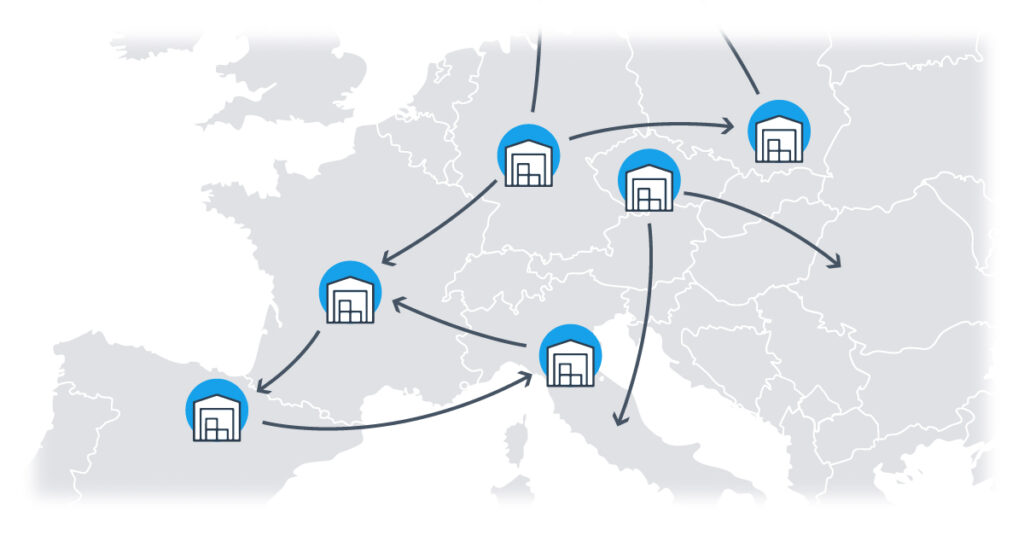
Storing goods in France usually creates a local VAT registration obligation, and once registered, French VAT returns are generally required as well. This applies both to independent storage and to fulfilment models such as Amazon FBA or third-party logistics providers.


Book a free consultation
Our VAT experts are happy to help you. Book a free consultation today!
3. You are participating in an FBA (Fulfilled-by-Amazon) program
- One of these storage options is Amazon’s FBA programs, in which products are stored in a variety of countries.
- For example, under the PAN-EU program, goods are stored in some Western European countries, including Spain, France and Italy.
- If you participate, you must register for VAT in all participating countries, as your products may be stored there.
- Sales from warehouses in France to customers in France must then be declared in a French VAT return.
Do you store goods in France or do you exceed the delivery threshold for distance selling?
In this case, VAT returns are mandatory in France. VAT registration in France is also required. Overwhelmed? Do not worry! We support you with the VAT registration and filing of returns. Contact us and keep focusing on your business in France.
Many online sellers use Amazon FBA in France, which often triggers VAT registration and filings due to local storage. Understanding how FBA affects VAT compliance is crucial to avoid penalties and keep operations running smoothly. For a step-by-step explanation, check our article on Amazon FBA VAT compliance in the EU
How to file
VAT Returns in France
VAT returns in France are generally filed electronically using the CA3 framework through the French tax authorities’ online system. In practice, monthly filing is the standard approach. Quarterly filing may be possible where annual VAT due is below €4,000. According to the French tax calendar, monthly filing and payment dates in 2026 generally fall between the 15th and 26th of the following month, depending on the taxpayer’s profile and filing setup.
In order to file VAT returns a business must first register with the french tax authorities and obtain a french VAT ID. In order to do so, an application including the VAT certificate of the country of origin, as well as an extract from the national trade register, needs to be submitted to the tax office in Paris.
Late or incorrect French VAT returns can trigger late-payment interest, fixed penalties for filing failures, and additional surcharges in more serious or repeated cases. This is one reason why filing deadlines and electronic submission requirements should be monitored carefully.
You can simplify both VAT registration and the filing of VAT returns in France by using the hellotax VAT automation tool. We help you automate VAT payments, correspond with the authorities, and make sure you stay VAT compliant!
Update 2026: France is moving toward broader digital VAT reporting and e-invoicing obligations, while the wider EU VAT in the Digital Age reforms continue to develop. Although most non-resident sellers still file French VAT returns under the current CA3-based framework, businesses should make sure their invoicing and VAT data processes are ready for future digital reporting changes.
For official guidance, the French tax authorities provide detailed information on how online sellers can use the OSS/IOSS system to manage VAT obligations for cross-border sales. This resource is especially useful for e-commerce businesses that want to simplify compliance while selling into France and across the EU. You can access it directly on the impots.gouv.fr website.
Not sure whether you need local French VAT returns or whether OSS covers part of your sales? hellotax can review your stock locations, sales flows, and filing obligations. Speak to our team here.
OSS and the EU-wide delivery threshold
Since July 2021, the EU-wide €10,000 threshold has applied to eligible intra-EU B2C distance sales. Once that threshold is exceeded, VAT is generally due in the customer’s country. Sellers can then either register locally where needed or use the One Stop Shop for eligible cross-border B2C sales. However, local French VAT registration and French VAT returns are still required if goods are stored in France or if another local VAT obligation exists.
The delivery threshold does not apply if a seller uses the One-Stop-Shop or OSS. In this case, each sale is taxed at a certain VAT rate, but returns are filed and all tax is paid in the home country. The authorities then distribute the correct amounts to foreign tax offices. VAT identification numbers and the submission of VAT returns are also not required as long as the goods are not stored abroad.
Example: You are a German distance seller with an annual net turnover of € 11,000 through sales to France, Spain, and Poland. If you take advantage of the regulations of the EU-wide delivery threshold, only the last € 1,000 turnover must be taxed with country-specific VAT rates such as the French one. But it is still mandatory to register and submit returns in each of the three countries, including France. If you use the OSS instead, € 11,000 of sales will be taxed at foreign VAT rates, but the entire VAT will be listed in VAT returns and paid in Germany. However, if you participate in a fulfillment program or have hired an e-fulfillment service provider, and goods may be stored in France, registration is still required. If goods are then sold to French customers from a French warehouse, these sales must be declared in France in an additional VAT return.
Not sure whether registering for OSS is the right thing to do? The hellotax team can advise you on this decision and continue to support you afterwards. We help with registrations for VAT or the OSS, with the submission of tax documents, and of course with the VAT payments.
If you’re selling across multiple EU countries, the One-Stop-Shop (OSS) scheme can simplify compliance by allowing you to declare all cross-border B2C sales in a single VAT return. This avoids having to register separately in each destination country. Learn more in our detailed guide: EU VAT OSS 2025: Simplify Compliance & Grow Faster
When do I need to file VAT Returns in France?
VAT returns in France are generally filed using the CA3 framework. According to the French tax calendar, filing and payment dates in 2026 typically fall between the 15th and 26th of the month following the tax period, depending on the taxpayer’s setup.
| Filing | How often? | Deadline? | Document? |
| VAT Return | Monthly or Quarterly | Between the 15th and 26th of the following month (depending on filing profile) | 3310 CA3-SD and 3310 A-SD in PDF format |
| VAT Return (Annex) | Monthly or Quarterly | Between the 15th and 26th of the following month (depending on filing profile) | 3310 A-SD (Annex) in PDF format |
| EC Listing | Monthly | 10th working day of the following month | CERFA_13964 (DES) |
| Intrastat | Monthly | 10th working day of the following month | CERFA_10838 (DEB) |
| VAT Group Return | Monthly | 24th of the following month | 3310-CA3G-SD in PDF format |
| 8th Directive | Yearly | January | 3519-SD in XML format |
French tax authorities have also intensified electronic audits comparing DEB, DES, and CA3 filings to identify inconsistencies. It’s crucial to keep records aligned.
Frequently Asked Questions
How often do I need to file VAT Returns in France?
In general, you need to file Returns on a monthly basis. Some businesses can choose to file quarterly Returns if their annual turnover and previous VAT amounts due lie below certain thresholds.
What happens if I didn’t file VAT Returns?
The penalties for late filings equal an interest charged on unpaid VAT of about 5%. Additionally there are 0,2% penalties for errors, as well as fines of up to 80% for repeated delays. Professionals at hellotax can also help you register for VAT and file Returns retroactively.
How do I register for VAT in France?
In order to obtain a VAT ID and start filing VAT Returns in France you need to fill out and submit an application for VAT registration with the french tax authorities. Some other documents, such as VAT certificates and an extract from the national trade register also need to be translated and submitted.
What are the different VAT rates in France?
In France, the standard VAT rate on goods and services is 20%. A reduced rate of 10% applies to some food items, transport, pharmaceuticals, cultural services, hotel accommodations, bars and cafés etc., while 5.5% apply on water supplies, books, events, and sanitary products and 2.1% apply to newspapers, cultural events and livestock.