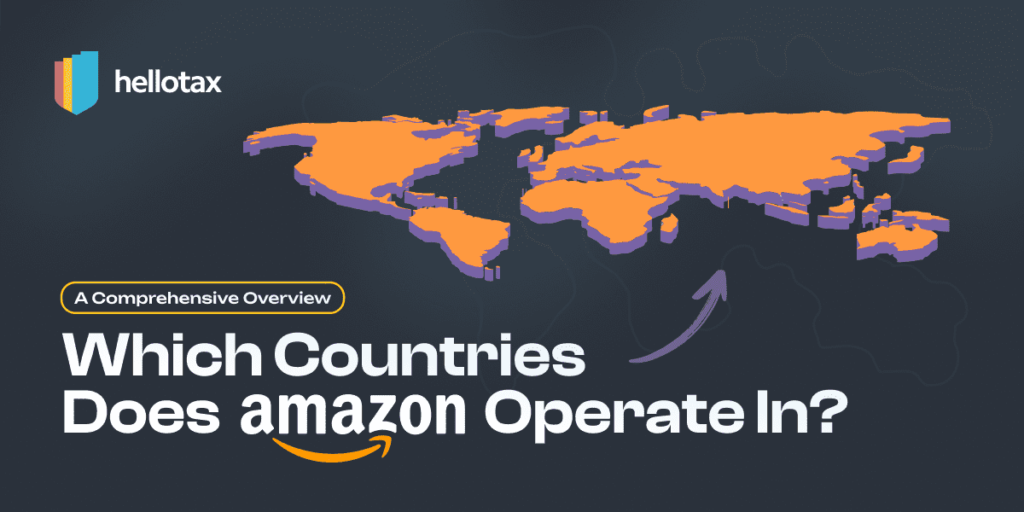
Which countries does Amazon operate in? As of 2026, Amazon operates dedicated stores across North America, Europe, Asia-Pacific, the Middle East, and Africa. For sellers, this matters because each Amazon marketplace comes with its own logistics setup, customer base, and in many cases its own VAT or indirect tax implications. In this guide, you will find a practical Amazon countries list, an overview of Amazon Europe countries, and the main VAT points online sellers should consider before expanding. Amazon’s seller guidance published in 2025 lists stores in the Americas, Europe, Asia-Pacific, and MENA/Africa, including newer European stores such as Belgium and Ireland.

Brenda Varela
Last Updated on 22 April 2026Selling on multiple Amazon marketplaces can trigger VAT registrations across Europe. If you need help with Amazon VAT compliance, storage analysis, or OSS, contact hellotax.
For EU-based sellers—or those wishing to sell in the EU—understanding Amazon’s European operations is essential. This guide will explain which countries Amazon operates in throughout Europe, how each market differs, and what the VAT implications are. Let’s explore in detail.
Curious about EU VAT compliance? Check out our OSS Guide for European Sellers on the hellotax blog.
For more Fulfillment by Amazon information, visit Amazon’s official FBA page.
1. Amazon’s Global Presence
If you are asking which countries does Amazon operate in, the answer is broader than many sellers expect. Based on Amazon seller materials and official Amazon launch announcements, Amazon currently operates dedicated stores in the following countries and regions:
Americas
United States, Canada, Brazil, Mexico
Europe
Belgium, France, Germany, Ireland, Italy, the Netherlands, Poland, Spain, Sweden, Turkey, United Kingdom
Middle East and Africa
Egypt, Saudi Arabia, South Africa, United Arab Emirates
Asia-Pacific
Australia, India, Japan, Singapore
These marketplaces have their own storefronts, languages, currencies, and fulfilment options. For sellers, the most important point is that Amazon’s global footprint creates different local tax and compliance obligations depending on where stock is stored and where goods are sold. Amazon’s own 2025 seller content lists these store locations, while separate official launch announcements confirm stores such as amazon.com.be in Belgium, Amazon.ie in Ireland, and Amazon.com.tr in Turkey.
If you want a fast answer to which countries have Amazon, here is the current short list of dedicated Amazon stores most relevant to international sellers:
United States, Canada, Brazil, Mexico, Belgium, France, Germany, Ireland, Italy, the Netherlands, Poland, Spain, Sweden, Turkey, the United Kingdom, Egypt, Saudi Arabia, South Africa, the United Arab Emirates, Australia, India, Japan, and Singapore. Amazon’s published seller guidance from 2025 confirms this global store footprint.
2. The Amazon Marketplaces in Europe
Knowing which countries does Amazon operate in across Europe can help you decide where to expand. Below are the main European marketplaces and key considerations for each:
2.1 Germany (amazon.de)
- Market Size: Germany is Amazon’s largest European market, with a substantial customer base.
- VAT & Invoicing: Storing products here usually requires a German VAT number and adherence to stricter invoicing requirements.
2.2 United Kingdom (amazon.co.uk)
- Post-Brexit Landscape: Although the UK is no longer part of the EU, it remains a top destination for online sellers.
- VAT & Customs: If you store goods in the UK and EU, you often need separate VAT registrations. Customs declarations are also necessary for cross-border shipments.
2.3 France (amazon.fr)
- Strong Demand: The French market offers robust e-commerce growth and a widespread FBA network.
- Compliance: Sellers storing inventory in France must register for French VAT and follow specific invoicing rules.
2.4 Italy (amazon.it)
- Growing E-commerce: Italy’s online market is expanding rapidly, making it appealing for international sellers.
- VAT Thresholds: If you hold stock in Italy or exceed distance-selling thresholds, Italian VAT registration is mandatory.
2.5 Spain (amazon.es)
- High Potential: Spain’s e-commerce sector has seen consistent growth in categories like fashion, electronics, and home goods.
- Local Storage: Storing products in Spanish warehouses triggers Spanish VAT obligations.
2.6 Netherlands (amazon.nl)
- Newer Marketplace: Although launched more recently, Amazon.nl is growing quickly.
- VAT Registration: You’ll need a Dutch VAT number if you store goods locally or surpass the distance-selling limit.
2.7 Sweden (amazon.se)
- Scandinavian Reach: Launched in 2020, Amazon Sweden helps you tap into Northern Europe.
- Local Compliance: Surpassing certain sales thresholds or storing items in Sweden requires Swedish VAT registration.
2.8 Poland (amazon.pl)
- Central Europe: Amazon Poland is another relatively new marketplace with a focus on Central and Eastern Europe.
- VAT Obligations: As with all EU countries, storing products in Poland means registering for Polish VAT.
2.9 Belgium (amazon.com.be)
- Local Marketplace: Amazon launched amazon.com.be in October 2022, giving sellers another local route into the Belgian market.
- VAT & Compliance: If you store goods in Belgium or make taxable local supplies there, Belgian VAT obligations may apply.
Belgium is now one of the important Amazon Europe countries to consider for Benelux expansion.
2.10 Ireland (amazon.ie)
- New European Store: Amazon officially launched Amazon.ie in March 2025.
- Seller Impact: Ireland now has its own dedicated Amazon marketplace, which matters for localisation, pricing, and VAT planning for sellers targeting Irish customers.
3. Cross-Border VAT Implications
When sellers ask “Which countries does Amazon operate in?”, they must also consider how these locations affect their VAT requirements. Here are four key areas to watch:
3.1 Storage of Goods
If you use Fulfillment by Amazon (FBA), your products might be stored in multiple EU countries. Each location typically requires local VAT registration, unless a special scheme or threshold rule applies.
3.2 Distance-Selling Thresholds and OSS
Before 2021, each EU state had its own distance-selling threshold. Now, there’s an EU-wide threshold of EUR 10,000 for small sellers, supported by the One-Stop Shop (OSS) system. Once you exceed this threshold, you must charge VAT based on the customer’s country. However, remember that storing goods locally always triggers VAT registration, regardless of the threshold.
3.3 VAT Rates
VAT rates in Europe vary from around 17% to 27%, depending on the country. Price your products carefully to accommodate these differences.
3.4 Invoicing Requirements
Countries like Germany and France are known for rigorous invoicing rules. Sellers must produce valid VAT invoices upon request and maintain accurate records for audits.
Check our checklist guide for a complete overview on VAT compliance.
Selling in multiple Amazon Europe countries can quickly lead to VAT registrations, local filings, and OSS questions. If you need help reviewing where your stock is stored and where VAT applies, speak to our VAT experts.
4. How Amazon’s Presence Affects Online Sellers
Now that you know which countries does Amazon operate in and the VAT complexities involved, let’s consider the broader impact on your business.
4.1 Wider Customer Base
Selling on Amazon’s multiple European sites grants you access to millions of potential buyers who trust Amazon’s brand for reliability and fast shipping.
4.2 Fulfillment by Amazon (FBA)
FBA can simplify logistics, but it also disperses your inventory across Amazon’s European warehouses. This distribution can trigger multi-country VAT registrations and administrative tasks.
4.3 Customer Trust and Reviews
Many European customers rely on Amazon for secure transactions and transparent review systems. Tapping into these marketplaces can quickly boost your social proof.
4.4 Competition and Fees
Amazon is highly competitive. Between referral fees, FBA costs, and VAT, you need to manage your margins carefully. Conduct thorough market research to set profitable prices.
4.5 Language and Cultural Adaptations
Localizing listings, product titles, and descriptions is vital for standing out. Consider hiring professional translators or using specialized localization services.
4.6 Complex VAT and Compliance Requirements
Multiple VAT registrations, different invoice obligations, and the OSS system can overwhelm new sellers. Expert help may save time and reduce costly errors.
5. Tips for Selling Successfully on Amazon’s European Marketplaces
- Research Demand and Competition
Identify where your products fit best. Some items thrive in the German market, whereas others may do better in Italy or Spain. - Leverage the One-Stop Shop (OSS)
OSS streamlines cross-border VAT reporting, but does not replace local registrations if you store goods in different EU countries. - Plan Your Logistics
Decide whether to store products in a single warehouse or use Pan-EU FBA. Balancing lower shipping costs with multi-country VAT complexity is crucial. - Keep Paragraphs Concise
Short paragraphs and headings help readers and improve your blog’s readability. - Use Transition Words
Terms like “furthermore,” “however,” and “in addition” guide readers through your content. - Stay Updated on Local Rules
European tax laws can change. Ensure you monitor new VAT regulations or partner with a compliance service such as hellotax. - Add High-Quality Images
Visuals break up text, showcase products, and enhance user experience—an important factor for conversions. - Seek Professional Assistance
Handling multiple VAT numbers and filing deadlines can be challenging. A specialized tax partner like hellotax can manage your registrations and compliance, letting you focus on growing your business.
If you are a US seller planning to operate in the EU, take a look at our article on US LLCs and how to stay VAT-compliant.
6. Conclusion
If you are wondering which countries does Amazon operate in, Amazon now runs dedicated stores across the Americas, Europe, Asia-Pacific, the Middle East, and Africa. For sellers focused on Europe, the key Amazon Europe countries now include Belgium, France, Germany, Ireland, Italy, the Netherlands, Poland, Spain, Sweden, Turkey, and the United Kingdom. Each market offers growth potential, but each may also create local VAT, invoicing, or customs obligations depending on where your goods are stored and sold. Amazon’s own seller materials confirm this broad global footprint, and newer launches such as Amazon.ie show that the network continues to expand.

Book a free consultation
Our VAT experts are happy to help you. Book a free consultation today!
Frequently Asked Questions
Which countries does Amazon operate in?
Amazon currently operates dedicated stores across North America, Europe, Asia-Pacific, the Middle East, and Africa, including the United States, Canada, Brazil, Mexico, Belgium, France, Germany, Ireland, Italy, the Netherlands, Poland, Spain, Sweden, Turkey, the UK, Egypt, Saudi Arabia, South Africa, the UAE, Australia, India, Japan, and Singapore.
Which countries have Amazon in Europe?
Amazon has dedicated European stores in Belgium, France, Germany, Ireland, Italy, the Netherlands, Poland, Spain, Sweden, Turkey, and the United Kingdom.
Why does this matter for VAT?
For sellers, the answer to which countries does Amazon operate in matters because local storage, domestic sales, and cross-border transactions can all affect VAT registration and filing obligations. In Europe, storing goods locally often creates a local VAT requirement even if OSS is used for some cross-border sales.
Quick Recap
- Which Countries Does Amazon Operate In?
Primarily the US, Canada, Mexico, Australia, Japan, India, and numerous European nations including Germany, the UK, France, Italy, Spain, the Netherlands, Sweden, and Poland. - Why Does This Matter for Sellers?
More markets mean bigger sales opportunities but also complex VAT rules. - Key Steps for Success
Register for VAT where goods are stored, watch out for distance-selling thresholds, leverage the One-Stop Shop (OSS), and localize your listings.
Need help handling VAT compliance across multiple Amazon EU marketplaces?
Contact hellotax today for expert guidance on registrations, filings, and everything in between. Good luck expanding your Amazon business across Europe!
Book a free consultation
Our VAT experts are happy to help you. Book a free consultation today!